
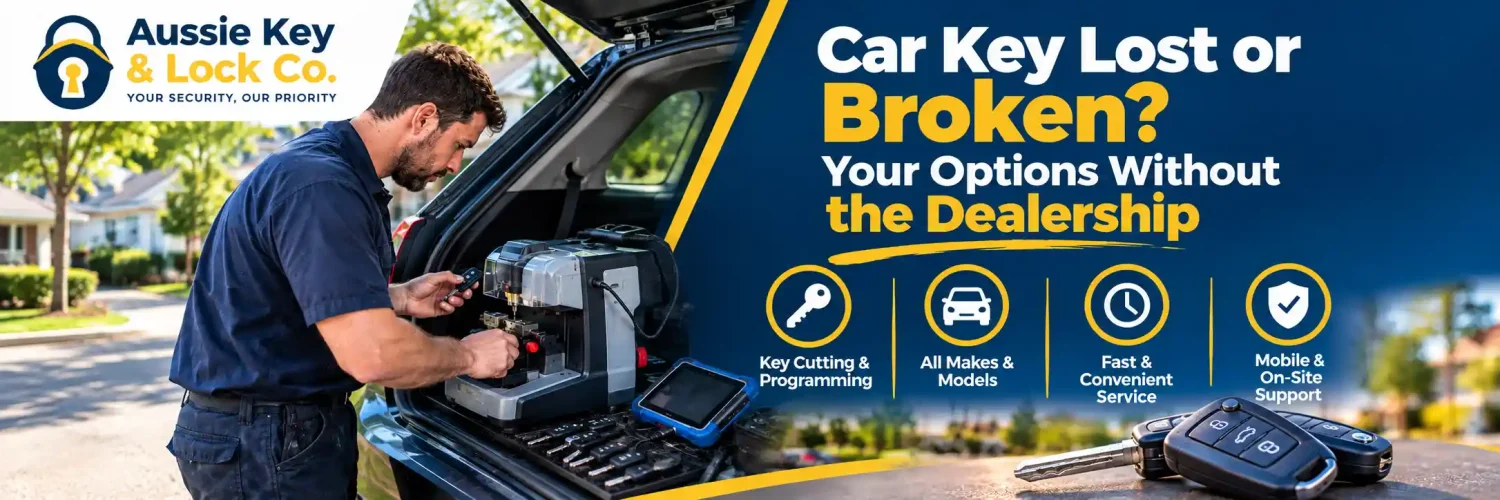
Losing a car key or snapping one off in the ignition tends to trigger the same first instinct: call the dealership. It feels like the obvious, safe choice, and for some vehicles it genuinely is the only viable path. But for a large share of everyday cars, lost car key replacement without dealer involvement is entirely realistic, often faster, and generally considerably cheaper. Understanding the actual options available changes how you approach the whole situation.
Option One: The Dealership Route
Going through the dealership means the manufacturer’s own parts and programming, which carries a certain reassurance for owners who want everything sourced directly from the brand. It’s also, realistically, the slowest and most expensive option in most cases.
Dealerships often need to order the specific key blank, may not have same-day programming capability on-site, and typically charge accordingly for both the part and the labour involved. For a newer or particularly high-security vehicle, this might genuinely be the only realistic path — but for the average car on Sunnybank’s roads, it’s rarely the only one.
Option Two: A Mobile Automotive Locksmith
A locksmith specialising in automotive work carries key-cutting and programming equipment covering a wide range of makes and models, and can typically come directly to you — your home, your workplace, or wherever the car currently is.
This matters considerably if the lost or broken key has left your vehicle stranded somewhere inconvenient, since it removes the need to get the car to a dealership in the first place. For most standard vehicles, a locksmith can cut a new key, program a transponder chip where the vehicle requires one, and have you back on the road in a single visit.
The main limitation here is vehicle-specific: a small number of newer, high-security vehicle models require dealer-level diagnostic equipment that even well-equipped mobile locksmiths don’t carry. This isn’t the norm, but it’s worth confirming your specific make and model when you call, rather than assuming every vehicle falls within standard locksmith capability.
What to Have Ready When You Call
Your vehicle’s make, model, and approximate year speed up the call considerably, along with confirmation of whether you have any working key remaining at all or whether every key has been lost. These details let a locksmith confirm upfront whether your vehicle is within their equipment’s range, rather than discovering a mismatch after they’ve already arrived.
Option Three: Key Duplication Services at Hardware or Big-Box Stores
For older, simpler vehicles without transponder chip technology, some hardware stores and big-box retailers offer basic key-cutting services. This is genuinely the cheapest option where it applies, but it’s also the most limited — it works only for basic mechanical keys, has no capability for programming electronic components, and generally can’t help at all if you’ve lost every key rather than needing a spare cut from an existing one. For most vehicles built in the last fifteen to twenty years, this option simply isn’t viable, since nearly all modern cars use some form of electronic key or transponder system these vehicles can’t handle.
Broken Key Specifically: A Different Set of Considerations
A key that’s snapped off — either in the ignition or the door lock — involves a slightly different process than a straightforward lost key. The broken piece typically needs extracting before anything else can happen, since a fragment left lodged in the mechanism will interfere with a replacement key’s operation. This extraction step is something a locksmith handles routinely, using specialised tools designed specifically for removing broken key fragments without damaging the surrounding lock or ignition components.
Once the fragment is out, the process largely mirrors a lost key situation — cutting and, where necessary, programming a replacement. The main difference is simply the extra extraction step at the start, which a dealership would also need to handle, often at a similar or greater cost than a mobile locksmith would charge for the same work.
What Not to Try Yourself
Attempting to extract a broken key fragment with household tools — tweezers, a paperclip, superglue on the exposed end — risks pushing the fragment deeper or damaging the internal mechanism further. What starts as a straightforward extraction can turn into a full ignition or lock replacement if amateur attempts make the situation worse first.
Weighing Cost Against Speed and Convenience
The genuine trade-off between these options usually comes down to a mix of cost, speed, and how much inconvenience you’re willing to absorb. Dealership replacement, while often the most expensive and slowest, carries manufacturer backing that some owners specifically want, particularly for vehicles still under warranty where non-dealer work might raise questions.
A mobile locksmith typically offers the best balance for most standard vehicles — meaningfully faster and cheaper than a dealership, while still handling the transponder programming that basic key-cutting services can’t.
For vehicles where a simple mechanical key genuinely is all that’s needed, the hardware store option remains the cheapest by a wide margin, though it’s increasingly rare to find a vehicle this basic still on the road.
What About Your Car’s Actual Security?
Losing a key raises a reasonable question beyond just getting a replacement made: does the lost key represent an ongoing security risk? Unlike a house key, most modern car keys can’t simply be used to identify and locate your specific vehicle without also knowing where it’s parked — but it’s still a reasonable moment to consider whether reprogramming the vehicle’s system to deactivate the lost key’s transponder chip is worth doing, particularly if the key was lost somewhere identifiable, like a wallet with other personal information, rather than simply misplaced at home.
A locksmith handling your replacement key can typically advise on this directly, since deactivating lost transponder codes is often a straightforward part of the same visit rather than a separate undertaking.
A Word on Modern Key Fobs and Push-Button Start
Vehicles with proximity key fobs and push-button start systems add a layer of complexity beyond a traditional cut key, since these fobs communicate wirelessly with the vehicle rather than relying purely on a physical cut. Losing one of these fobs, or having it stop working due to a dead internal battery being mistaken for a lost key, requires slightly different handling.
A qualified automotive locksmith can typically supply and program a replacement fob for most mainstream vehicle brands, though this is precisely the category where confirming capability upfront matters most, since fob programming requirements vary considerably between manufacturers and even between model years of the same vehicle.
It’s also worth checking the simple explanation first: a fob that’s stopped working entirely, rather than being genuinely lost, sometimes just needs a battery replacement — a five-minute, low-cost fix that’s easy to overlook when the more dramatic assumption of “I need an entirely new key” takes over.
How Long Does This Actually Take?
For a standard lost or broken key situation involving a common vehicle make, a mobile locksmith visit typically resolves the entire issue — extraction if needed, cutting, and programming — within a single appointment, often completed on the spot rather than requiring a return visit. This stands in fairly stark contrast to dealership timelines, where ordering a specific key blank and scheduling programming can sometimes stretch the process out over several days, particularly for less common models where parts aren’t kept in standard stock.
This time difference matters more than it might initially seem, especially if the lost or broken key has left you without transport for work, school pickups, or other daily obligations that don’t pause simply because your car key has.
Choosing Based on Your Specific Situation
There’s no single universally correct answer between these three options — the right choice depends on your specific vehicle, how urgently you need the car back in service, and your own comfort level with each approach. A newer vehicle still under manufacturer warranty might genuinely warrant a dealership conversation first, if only to confirm whether non-dealer key work affects that warranty in any way. An older, more common vehicle with a straightforward mechanical or basic transponder key is usually well served by a mobile locksmith, without any of the downsides that come with dealership timelines and pricing.
Conclusion
Lost car key replacement without dealer involvement is a genuinely realistic path for the vast majority of vehicles, and for most Sunnybank drivers, it’s both faster and considerably more affordable than the dealership route most people default to automatically. A mobile automotive locksmith bridges the gap between the dealership’s full manufacturer backing and a hardware store’s basic, limited capability — covering transponder programming and broken key extraction that a simple key-cutting kiosk simply can’t handle.
Before assuming a dealership visit is your only option, it’s worth a quick call to confirm whether your specific vehicle falls within standard locksmith capability. For most everyday cars, the answer is yes, and the whole situation resolves considerably faster and cheaper than the default assumption suggests.