
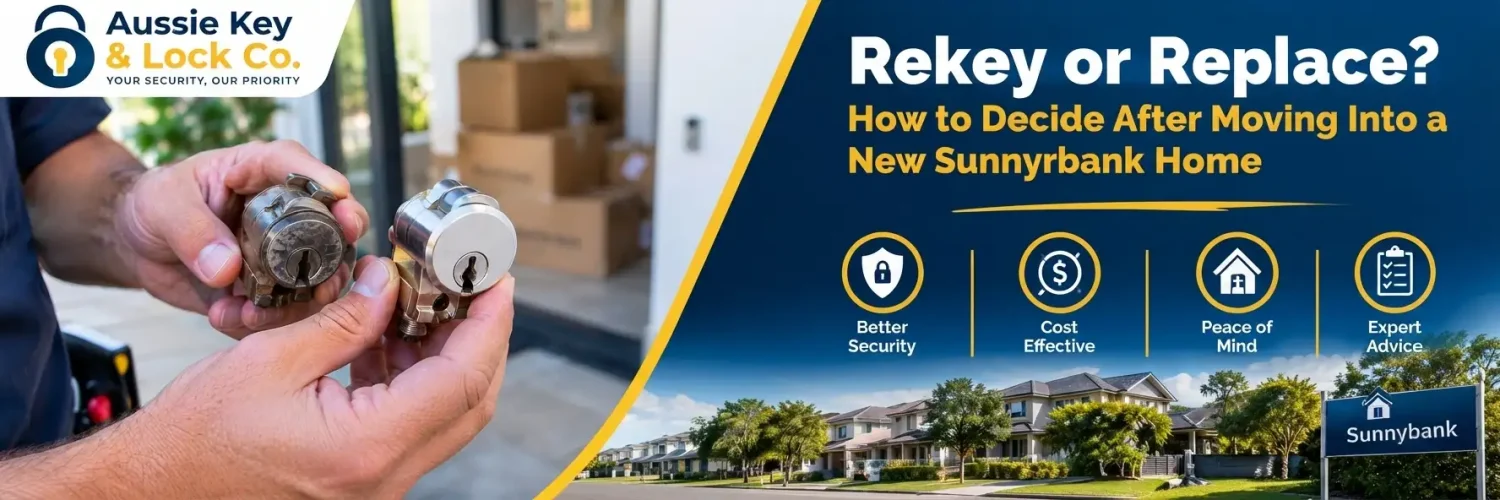
Settlement day comes with a long list of things to sort out, and lock security often gets reduced to a single question: should I rekey or replace the locks on my new home? The honest answer depends on a handful of specific factors about the property itself, and working through them properly leads to a genuinely better decision than defaulting to whichever option sounds more thorough.
Start Here: What’s the Actual Condition of the Existing Locks?
Before considering cost or convenience, the physical state of your new home’s locks should drive the initial decision. Locks that turn smoothly, show no visible rust or damage, and are a reasonably modern style with decent security ratings are generally worth keeping and simply rekeying.
Locks that are visibly aged, sticky, corroded, or clearly outdated in terms of security features are a different story — rekeying an old, worn-out lock just means old, worn-out hardware with fresh internals, rather than a genuine security upgrade.
A quick inspection during your final walkthrough, or shortly after settlement, gives you the information needed to make this initial call honestly, rather than guessing based on how the property looked overall.
Factor One: How Many Previous Key Holders Realistically Existed
If rekeying is on the table based on the locks’ physical condition, the next question is how much genuine security benefit rekeying actually provides for this specific property. A home with a single previous owner who lived there for decades, sold directly without a real estate agent, and handed over keys personally has a fairly contained history of who might hold a copy.
A property that’s passed through several tenancies, multiple agents, and various tradespeople over recent years has a considerably wider — and less knowable — pool of potential key holders.
The wider that pool, the stronger the case for rekeying becomes, even if the locks themselves are in perfectly good physical condition. Rekeying addresses exactly this uncertainty, regardless of how well the hardware itself is performing mechanically.
Factor Two: Whether the Locks Meet a Reasonable Security Standard
Separate from who might hold a key, it’s worth honestly assessing whether your new home’s existing locks meet a standard you’re comfortable with. A front door relying solely on a basic spring latch, with no deadbolt at all, represents a security gap that rekeying doesn’t address — rekeying only changes who can open the existing lock, not how resistant that lock is to forced entry in the first place.
In this situation, replacement — specifically adding proper deadbolt hardware where it’s missing — is the more relevant fix, regardless of the previous-owner question entirely. Some homes genuinely need both: rekeying for the uncertainty around previous access, and replacement or upgrading for hardware that was never adequate to begin with.
A Quick Standard to Check Against
At minimum, every external door should have a proper deadbolt with a reasonable throw length, not just a spring latch. If this is missing anywhere on your new Sunnybank property, that’s a replacement conversation regardless of what you decide about rekeying.
Factor Three: Your Own Timeline and Budget
Rekeying is almost always faster and less expensive than full replacement, since it works with your existing hardware rather than requiring new locks to be purchased and fitted. For homeowners wanting security addressed immediately, ideally on the day they collect keys, rekeying is usually achievable same-day in a way that ordering and fitting entirely new hardware often isn’t, particularly if you’re set on a specific style or a smart lock system that needs to be sourced first.
This doesn’t mean rekeying should be chosen purely for speed if the underlying hardware genuinely needs replacing — but where the locks are in decent shape and the only real concern is previous key holders, rekeying’s speed and lower cost make it the sensible default rather than something to upgrade away from unnecessarily.
Factor Four: Whether You Actually Want to Change the Look or Function
Beyond pure security considerations, some homeowners simply want different hardware — a particular finish, a smart lock system, or matching style across all external doors that the existing mismatched locks don’t currently provide. This is a perfectly valid reason to choose replacement over rekeying, even if the existing locks were otherwise in fine working condition and posed no particular security concern.
It’s worth being honest with yourself about which category your decision actually falls into — a genuine security or condition concern, versus simply wanting different hardware for aesthetic or convenience reasons. Both are legitimate, but they lead to different urgency levels and different conversations with whoever you’re arranging the work through.
Putting It Together: A Realistic Decision Process
Walking through this in order — condition first, then previous key holder history, then whether the security standard itself is adequate, then your own timeline and preferences — usually produces a clear answer rather than leaving you stuck between two options that both sound reasonable in the abstract. Most Sunnybank homebuyers moving into an established property with decent, modern locks end up choosing rekeying alone. Those moving into a property with genuinely outdated or inadequate hardware often need at least some replacement, sometimes alongside rekeying for doors where the existing lock is fine but the key history is uncertain.
What This Looks Like in a Mixed Scenario
It’s common for a single property to need different treatment on different doors. A front door with a solid, modern deadbolt might only need rekeying, while a side entrance still running on decades-old original hardware genuinely warrants replacement.
Treating each door individually, rather than applying one blanket decision across the entire property, usually produces the most sensible outcome — and it’s a completely reasonable way to approach the conversation with a locksmith assessing your new Sunnybank home.
What If You’re Genuinely Unsure?
Not every property falls neatly into an obvious category, and it’s entirely reasonable to want a second opinion rather than making the call entirely on your own. A locksmith assessing your new Sunnybank home can generally give you an honest read within a single visit — checking the physical condition of existing hardware, flagging any doors missing proper deadbolts, and helping you weigh the previous-ownership question based on whatever you know about the property’s sale history.
This assessment is worth having even if you’ve already leaned toward one option, since it’s a low-effort way to confirm your instinct is right, or to catch something you might have missed during your own walkthrough. Doors get overlooked easily — a side gate leading to a rear entrance, a laundry door, anything not part of the main front-of-house impression a property makes during inspections.
The Cost of Getting This Decision Wrong
Choosing rekeying when replacement was genuinely warranted means living with inadequate hardware while believing the security question has been handled — arguably worse than doing nothing at all, since the false confidence can lead to other habits, like not double-checking doors are properly locked, that compound the underlying risk.
Choosing full replacement when rekeying alone would have sufficed isn’t a security problem, but it does mean spending more time and money than the situation actually required, on hardware that wasn’t the genuine issue in the first place.
Neither mistake is catastrophic, but both are avoidable with a small amount of upfront, honest assessment — which is really the core argument for working through the factors above properly rather than picking whichever option feels instinctively “safer” without actually checking.
Timing This Around Your Actual Move
Ideally, this entire assessment happens before or immediately at settlement, rather than being pushed back for weeks while other moving tasks take priority. The security gap that either rekeying or replacement addresses exists from the moment you take possession of the property, not from whenever you eventually get around to arranging the work. Booking a locksmith visit for the same day you collect keys, or as close to it as practically possible, closes that gap as early as it can reasonably be closed.
Conclusion
Deciding to rekey or replace after moving into a new Sunnybank home isn’t really a single choice so much as a short series of honest assessments — the physical condition of what’s already there, how many people might reasonably still hold a key, whether the existing security standard is genuinely adequate, and what your own timeline and preferences actually call for.
Working through these factors properly, rather than defaulting automatically to whichever option feels more thorough, means the security work you arrange actually matches what your new home genuinely needs — no more, and importantly, no less.