
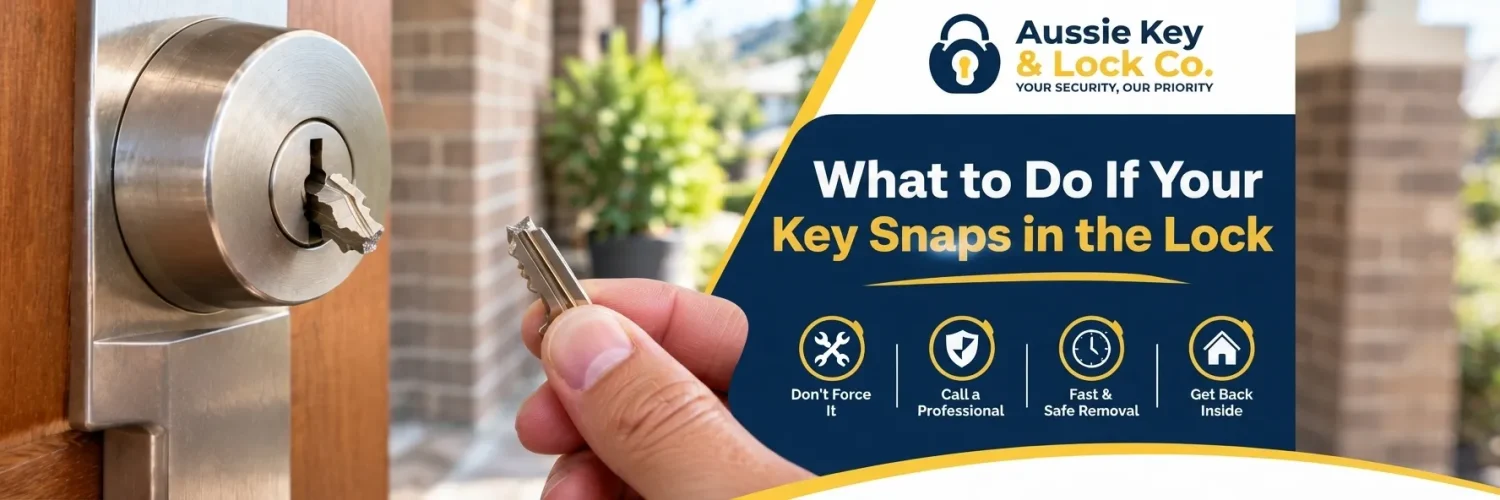
There’s a distinct, sinking feeling that comes with feeling a key give way mid-turn — that small crack, followed by realising half your key is now sitting somewhere it shouldn’t be. Key snapped in lock situations happen more often than most people expect, and what you do in the immediate aftermath genuinely affects whether it’s a quick fix or a much bigger problem.
Do This First: Stop Turning Immediately
The instinct once a key snaps is often to keep trying — turning the remaining stub, wiggling it, hoping the mechanism somehow completes the motion anyway. Resist this entirely. Continuing to force a broken key stub deeper into the mechanism risks pushing the fragment further in, making eventual extraction considerably harder, and can damage the internal pins in ways that turn a simple key extraction into a full lock repair or replacement.
The moment you feel or hear that snap, stop. Assess the situation calmly before doing anything else.
Don’t Do This: The Common Mistakes That Make It Worse
A few instinctive reactions genuinely make a snapped key situation worse rather than better. Attempting to extract the fragment with household tools — tweezers, a paperclip bent into a hook, a small screwdriver jammed alongside the stub — risks pushing the piece deeper or scratching the internal pins in ways that affect the lock’s function even after the fragment is eventually removed properly.
Superglue applied to the exposed end of the broken key, in hopes of gluing it to something and pulling it out, is a particularly common mistake that often ends with glue inside the lock mechanism itself, adding an entirely new problem on top of the original one.
Spraying oil-based lubricants into the lock, hoping to ease the fragment out, is another common instinct that generally does more harm than good — the added lubricant can carry debris further into the mechanism rather than helping the fragment slide free.
The One Thing Worth Trying Yourself
If a small portion of the broken key is still visibly protruding from the lock, and you have proper needle-nose pliers on hand, a single gentle, straight-line pull — no twisting, no force — is reasonable to attempt. If it doesn’t come free within one or two gentle attempts, stop and call a locksmith rather than escalating your own efforts.
Then This: Assess Whether You’re Actually Locked Out
A snapped key doesn’t automatically mean you’re locked out entirely — it depends on exactly when the break happened. If the key snapped while you were unlocking a door you’re currently standing outside of, you’re dealing with both a broken key and a lockout simultaneously. If it happened while locking up on your way out, or while the door was already open, the immediate situation is less urgent, even though the broken key itself still needs proper attention.
This distinction matters for how quickly you need help. A genuine lockout combined with a broken key fragment calls for prompt assistance, particularly outside daylight hours or in bad weather. A broken key with the door still accessible gives you more breathing room to arrange a convenient appointment time instead.
Calling for Help: What a Locksmith Actually Does
Extracting a broken key fragment is a routine job for a properly equipped locksmith, using specialised extraction tools designed specifically for this purpose — thin, hooked instruments that can grip and remove a fragment without the damage that improvised household tools risk causing. In most cases, the fragment comes out cleanly, and the existing lock continues functioning normally afterward, meaning you’ll likely just need a replacement key cut rather than any hardware replacement at all.
Occasionally, the extraction reveals that the lock’s internal pins have sustained some wear or damage — either from the original break itself or from any DIY extraction attempts made beforehand. In these cases, a locksmith can advise honestly on whether a repair is sufficient or whether the lock genuinely needs replacing, rather than assuming the worst outcome by default.
Why Keys Actually Snap in the First Place
Understanding the underlying cause helps prevent a repeat situation. Metal fatigue from years of regular use is a common culprit — keys flex slightly with every turn, and that repeated stress eventually weakens the metal at its narrowest point, usually right where the key meets the bow, or handle section.
A key that’s been copied multiple times from an already-worn original sometimes inherits imperfections that make it more prone to snapping than a properly cut original would be.
A stiff or poorly maintained lock also contributes significantly. If a lock already requires considerable force to turn — a sign worth addressing on its own — that extra pressure transfers directly onto the key itself, increasing the odds of a break considerably compared to a smoothly operating lock that doesn’t demand the same effort.
A Practical Habit Worth Adopting
If your key has felt stiff or required more effort than usual over recent weeks, treat that as an early warning rather than something to keep pushing through. Addressing lock stiffness before it results in a snapped key is considerably simpler and cheaper than dealing with the aftermath.
After the Fragment’s Out: Preventing a Repeat
Once the immediate situation is resolved, it’s worth a genuine conversation with the locksmith about whether the lock itself needs any attention, rather than simply walking away with a fresh key and assuming the problem is fully solved. If the original break was caused by lock stiffness rather than simple key fatigue, cutting a new key without addressing the underlying stiffness just sets up the same failure to happen again eventually.
It’s also worth having a spare key cut at this point, if you don’t already have one, given that you’ve just experienced firsthand how disruptive being without a working key genuinely is.
What About Keys That Snap Inside a Car Door or Ignition?
Everything above applies broadly to house and car keys alike, but vehicle-specific keys add a couple of extra wrinkles worth knowing about. A key that snaps in the ignition, rather than a door lock, means the vehicle typically can’t be started at all until the fragment is removed and a replacement is cut — and for transponder-equipped keys, that replacement also needs proper programming to communicate with the vehicle’s immobiliser system. This isn’t something a standard household extraction attempt has any hope of resolving even partially, since the ignition cylinder sits deeper within the vehicle’s steering column assembly than a door lock does.
A key snapping in a car door lock, by contrast, behaves much more like the house lock scenario described above — a fragment extraction followed by a new key cut, without the added ignition and programming complexity. Being clear about exactly which lock the break happened in, when you call, helps a locksmith bring the right equipment for either scenario rather than assuming one or the other.
How to Tell If DIY Extraction Attempts Have Already Made Things Worse
If you’ve already tried extracting the fragment yourself before deciding to call for help, it’s worth mentioning this honestly rather than leaving it out, even if the attempts didn’t go particularly well. Signs that an amateur extraction attempt may have caused additional damage include a lock that now feels looser or more resistant than it did immediately after the break, any visible scratching around the keyhole itself, or a sensation of grinding rather than a clean mechanical action when the key or extraction tool moves within the lock.
None of this is something to feel embarrassed about mentioning — locksmiths deal with post-DIY-attempt situations regularly, and being upfront about what’s already been tried means they can assess the actual current state of the lock accurately, rather than working from an assumption that doesn’t match reality.
Conclusion
A key snapped in lock situation feels alarming in the moment, but it’s one of the more routine calls a locksmith handles, provided you avoid the common mistakes that turn a simple extraction into something more complicated. Stop turning immediately, avoid DIY extraction beyond a single gentle attempt with the right tool, and call for help with a clear sense of whether you’re also facing an active lockout.
Handled properly, a broken key rarely means anything more than a straightforward extraction and a fresh key cut. Handled poorly, with force, superglue, or improvised tools, it can turn into a genuinely bigger job — which is exactly why the first sixty seconds after that snap matter more than they might seem to in the moment.