
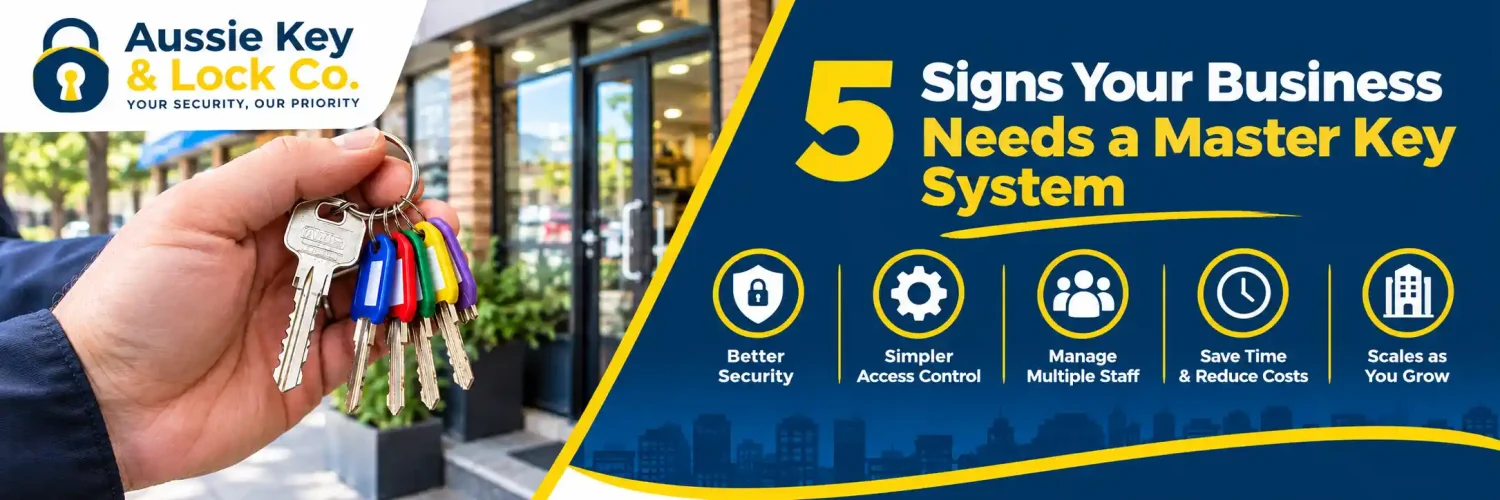
Most small business owners never think about their key system until it’s already become a genuine headache — a bulging keyring, a departed employee whose keys never made it back, a locked storeroom nobody remembers who has access to. A master key system for business premises solves exactly this kind of accumulated mess, but recognising when your business has actually reached that point isn’t always obvious from the inside. Here are five situations that suggest it’s time to consider one.
Sign One: Your Staff Are Carrying More Keys Than Makes Sense
If employees are juggling separate keys for the front entrance, the stockroom, individual office doors, and a filing cabinet or two, something has gone wrong with how access is structured. Beyond the simple inconvenience of a jangling keyring, this scattered approach makes it genuinely difficult to track who can access what, since the answer lives in each individual’s memory of which keys they happen to be holding rather than in any centralised, reviewable system.
A properly designed master key system for business use consolidates this considerably. Staff can carry a single key granting access to everything relevant to their role, while a master key held by management or ownership opens everything across the premises. The reduction in physical keys is a nice side effect, but the real value sits in having a clear, documented access hierarchy rather than an informal patchwork that’s grown organically over years.
Sign Two: You’ve Had to Rekey Everything After a Single Lost Key
Without a master system, a single lost key sometimes forces a business into rekeying every lock that key could open, simply because there’s no way to know for certain where it ended up or who might find it. This is expensive, disruptive, and often out of proportion to the actual risk posed by one missing key for a single door.
A master key system changes this calculation considerably. Individual sub-keys can be rekeyed in isolation without touching the master key or affecting any other lock in the system, meaning a lost key for the stockroom doesn’t require rekeying the front entrance, the manager’s office, and everything else along with it. This isolation alone often justifies the upfront setup cost within the first genuine incident it prevents from spiralling.
A Common Scenario Worth Recognising
A staff member leaves their keys in a café, at the gym, or somewhere else outside work entirely. Without a master system, this single mundane mistake can trigger a full-premises rekey. With one in place, only that specific staff member’s access needs addressing.
Sign Three: Staff Turnover Has Become a Security Headache
Every business with regular staff turnover eventually faces the same uncomfortable question: how many former employees still technically hold a working key? Without a system for tracking and revoking access cleanly, this number tends to grow steadily over time, particularly in industries with seasonal or casual staff who come and go more frequently than a small business’s admin processes can always keep pace with.
A master key system doesn’t eliminate this problem entirely, but it makes addressing it considerably more manageable. Sub-keys tied to specific roles or areas can be reissued or reconfigured without disturbing the broader system, meaning staff turnover becomes a routine administrative task rather than a recurring security scramble.
Sign Four: Different Roles Genuinely Need Different Levels of Access
A retail business, for instance, might reasonably want casual floor staff able to access the shop floor and a staff room, while only supervisors can reach the stockroom, and only ownership or senior management can access a safe or cash office. Trying to replicate this hierarchy with individually cut, unrelated keys means either over-granting access for convenience or creating an unwieldy number of separate keys that becomes its own management problem.
A properly structured master key system encodes this hierarchy directly into the hardware itself. Access naturally follows role, and adjusting that hierarchy as the business grows or restructures is a matter of reissuing specific sub-keys rather than rethinking the entire premises’ locking arrangement from scratch.
Sign Five: You’re Managing Multiple Premises or Expanding
Businesses operating across more than one Sunnybank location, or planning to expand into additional premises, face a scaling version of every problem above. Coordinating separate, unrelated key systems across multiple sites multiplies the administrative burden considerably, and makes any kind of centralised oversight — knowing who can access which location — genuinely difficult without a unified structure underlying it.
A master key system can be designed to extend across multiple premises from the outset, with a top-level master opening everything across every site, and site-specific or role-specific sub-keys handling more granular access at each individual location. Setting this up properly during an expansion, rather than retrofitting it once multiple disconnected systems already exist, saves considerable disruption later.
What Setting One Up Actually Involves
Establishing a master key system starts with a proper audit of your premises — every door, every access point, and a clear picture of which roles genuinely need access to which areas. From there, a locksmith designs a keying hierarchy matching your actual operational structure, rather than a generic template that doesn’t reflect how your specific business actually functions day to day.
This is worth treating as a genuine planning exercise rather than a quick hardware swap. Businesses that invest proper thought into the access hierarchy upfront — rather than simply replicating whatever informal system already exists — end up with something that scales cleanly as the business grows, rather than needing significant rework within a year or two.
Weighing the Investment Against the Ongoing Cost of Not Having One
It’s reasonable for a business owner to weigh the upfront cost of installing a master key system against simply continuing with the current, if imperfect, arrangement. The honest comparison isn’t the master system’s cost against doing nothing — it’s the master system’s cost against the accumulated cost of repeated full-premises rekeys, the administrative time spent tracking scattered keys, and the genuine security risk of not knowing with confidence who can currently access your business. Framed this way, the calculation tends to favour a proper system for any business experiencing more than one of the signs above.
Making Sure a System Actually Solves Your Problem
A master key system for business premises isn’t just a convenience upgrade — it’s a structural fix for a set of problems that tend to compound quietly over time until they become genuinely disruptive. Scattered keys, expensive full-premises rekeys triggered by single losses, unclear access after staff departures, mismatched access levels across roles, and the complexity of managing multiple sites are all symptoms of the same underlying gap.
If your Sunnybank business is showing two or more of these signs, it’s worth having a proper conversation with a locksmith about what a master key system would actually look like for your specific premises, rather than continuing to manage an informal system that’s already outgrown its usefulness.
Questions Worth Asking Before You Commit
Before arranging an installation, it’s worth clarifying a few practical points with whoever you’re working with. Ask how the system handles future changes — adding a new role, removing access for a departing staff member, or expanding to a new area of the premises — since a system that’s rigid and difficult to adjust after installation defeats much of the original purpose. A well-designed system should accommodate reasonable future changes without requiring a complete rebuild each time circumstances shift.
It’s also worth asking about key control — specifically, whether the sub-keys and master keys use patented or restricted key blanks that can’t simply be duplicated at any hardware store without authorisation. This detail matters considerably for long-term security, since an otherwise well-designed hierarchy loses much of its value if any sub-key holder can walk into a shop and have an unauthorised duplicate cut without your knowledge.
Common Misconceptions Worth Addressing
Some business owners assume a master key system is only relevant for large operations with dozens of staff and multiple floors, but the underlying logic applies just as usefully to a small operation with a handful of employees and two or three access points. Even a modest business benefits from the clarity of knowing exactly who can access what, without needing to reach the scale of a large enterprise first to justify the setup.
There’s also a common assumption that a master key system is primarily about restricting access — locking staff out of areas they don’t need. In practice, it’s equally about simplifying access for the areas staff genuinely do need, replacing a cluttered keyring with a single, properly scoped key that covers everything relevant to their actual role. The security benefit and the convenience benefit tend to arrive together, rather than one coming at the expense of the other.
Conclusion
A master key system for business premises isn’t just a convenience upgrade — it’s a structural fix for a set of problems that tend to compound quietly over time until they become genuinely disruptive. Scattered keys, expensive full-premises rekeys triggered by single losses, unclear access after staff departures, mismatched access levels across roles, and the complexity of managing multiple sites are all symptoms of the same underlying gap.
Taking the time to ask the right questions upfront — about flexibility, key control, and how the system scales with your business — means the investment actually solves the problem you set out to fix, rather than simply relocating the same headaches into a more expensive form.